

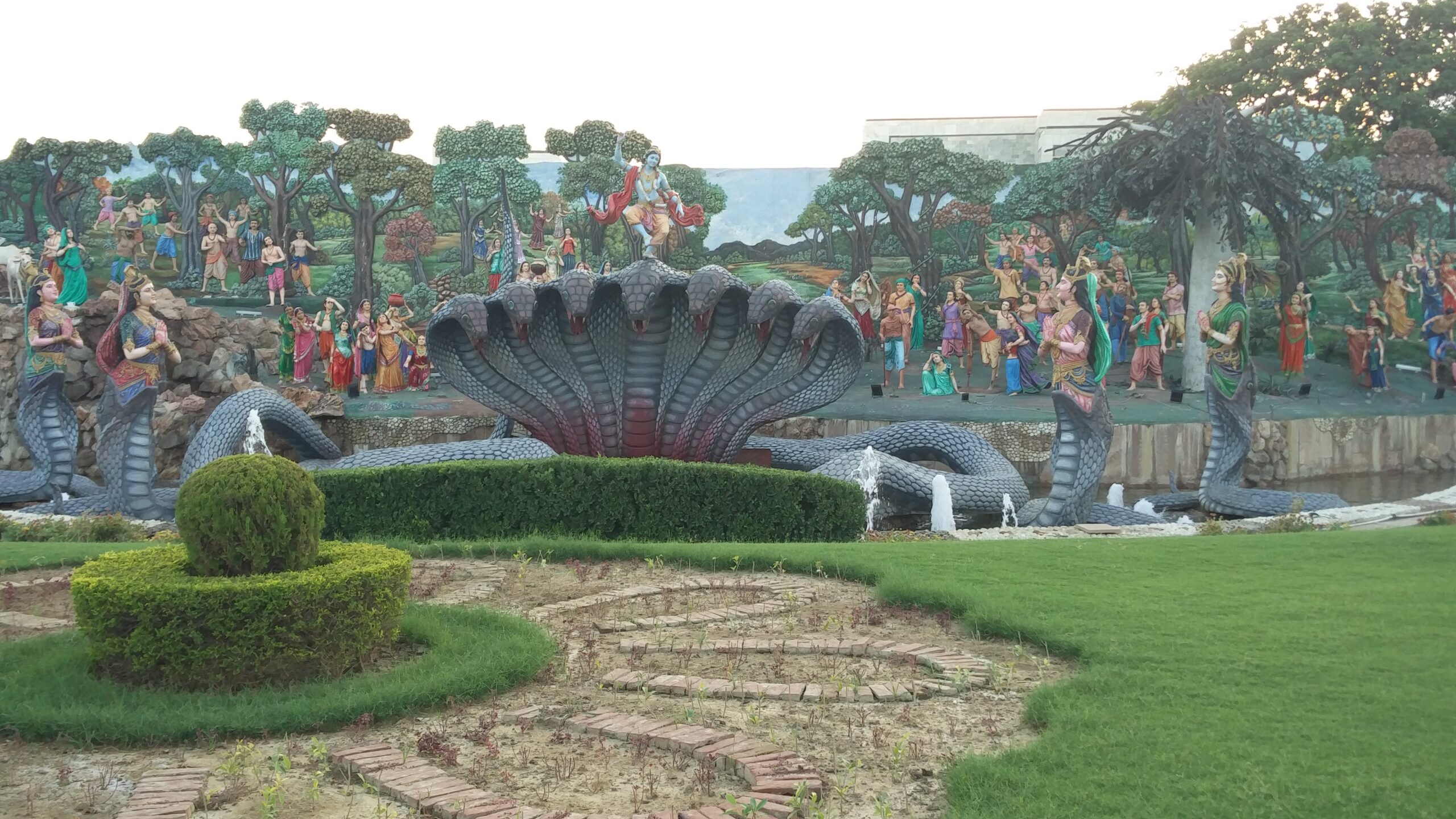
Vrindavan is, perhaps, the only place in India where one can really be like a breathing legend and feels like living. This ancient town is the alleged residence of the childhood and youth of Lord Krishna and is located on the banks of the sacred Yamuna River in Uttar Pradesh. Each street, each shrine, here speaks Bhagavata and Purana. If you are a faithful pilgrim or a wandering traveller, Vrindavan will give you no experience like it. It is full of devotion, colour, music and immortal mythology.
This is a comprehensive guide to all first-time travellers who would want to know how to get there, the best places to visit, the best places to stay as well as the hidden secrets that will make this trip worth remembering.
Why Visit Vrindavan?
Vrindavan is one of the most sacred towns in Hinduism as it is the town where Lord Krishna spent his divine childhood. There are more than 5,000 temples in the town crowded into a rather small space, so the place is vibrating with spirituality 24 hours a day. The strains of bhajans, the odour of flowers and the jolly pandemonium of pilgrims from all over the world are making the streets come alive. However, its spirituality apart, Vrindavan is a feast of the senses, a palette of colour, culture and cuisine.
Best Time to Visit Vrindavan
Vrindavan can be visited all year round, but there are special occasions that make the visit especially special during specific seasons.
The best time to visit Vrindavan is from October to March, when it is pleasant. It is cool and comfortable, with weather suitable for taking a walk around temples and ghats. You should visit during March or April in order to experience the most iconic Holi festivities in the world. Vrindavan Holi is a month-long event, and the Lathmar Holi of Barsana is a remarkable sight. To people wishing to feel like part of Janmashtami, the birth anniversary of Krishna, July to August turns Vrindavan into a pool of religious devotion and celebrations in the middle of the night that are simply electric.
How to Reach Vrindavan
Air: The closest one is the Pandit Deen Dayal Upadhyaya Airport in Agra, which is approximately 70 km. It is much better connected from Indira Gandhi International Airport in New Delhi (approximately 145 km). A taxi or cab aggregator application will comfortably take you to Vrindavan in whichever of the two airports.
Train: Vrindavan is closest to the Mathura Junction, which is only 12 km. It is well interconnected to Delhi, Agra, Jaipur and most of the key Indian cities. Out of Mathura, a rickshaw and a communal tempo also operate regularly to Vrindavan.
Air: Vrindavan can be reached through National Highway 19. Delhi (ISBT Kashmere Gate) and Agra buses to Mathura are common, and there is easy transport to Vrindavan in Mathura. It is about 2.5-3 hours to drive self-driven to Delhi, depending on the traffic.
Major Temples to Visit in Vrindavan
The temples of Vrindavan are the soul. The following is the list of the must-visit ones for every first-time traveller.
Banke Bihari Temple is the favourite temple in Vrindavan, where Lord Krishna is worshipped in his mischievous form. This is a very emotional experience due to the swinging curtain ritual (parda) and the energies of the devotees who are contagious. Visit during Aarti hours to have a greater effect.
Chaar Dham Temple is among the most visited and spiritual sites in Vrindavan. The temple complex has 4 dham’s, in one divine site, the temple of Shiv Dham, Radha Krishan Dham, Shani Dham, and Maa Vaishno Dham. The complexity of the frescoes, sculptures and statues makes the complex emit an atmosphere of reverence and wonder. It is a complex that cannot be missed, whether you are a pilgrim who fulfils a symbolic Chaar Dham darshan or you are just a visitor who wants to have spiritual peace.
ISKCON Vrindavan (Krishna Balaram Mandir): One of the most beautiful temples made of marble is the Krishna Balaram Mandir (ISKCON Vrindavan). One of the most spiritual experiences in the area is the evening aarti here
Prem Mandir is an exquisite white marble temple whose elaborate carvings, which show scenes in the life of Radha and Krishna, are astonishing. The light-and-music fountain afternoon show is one of the visual attractions of any age to visitors.
Radha Raman Temple: Among one of the Vrindavan’s oldest temples is the Radha Raman Temple, which has an eternal flame burning for almost 500 years. This temple has a sense of silence, intense piety.
Nidhivan is a sacred forest grove, which is said to be the place where Krishna and Radha spent their time in an eternal Raas Lila. The crooked trees and the spooky sacred theme make it unlike any other part of Vrindavan.
Suggested 2-Day Itinerary for First-Time Visitors
Day 1 – Temples and Ghats
Begin your morning at the Banke Bihari Temple. Then visit Radha Raman Temple, which is a more spiritual experience. In the afternoon visit Nidhivan after lunch in a local dhaba. Spend your day at Kesi Ghat on the Yamuna, generally lovely in the evening, especially at sunset, and attend the evening aarti.
Day 2 – Chaar Dham, ISKCN and Prem Mandir.
Start the second day with morning aarti at Krishna Balaram Mandir, the ISKCON. Then there is the Chaar Dham Temple Complex which should be visited after breakfast. The size and calmness of the place are worth at least one or two hours. During the afternoon, rest and go slowly through the carvings. Evening, Back to Prem Mandir to watch the Light show.
Essential Travel Tips for Vrindavan
Dress modestly. Vrindavan is a very religious place, cover your shoulders and legs in temples and take off your shoes before you enter the temple compound.
Watch out for monkeys. The town boasts of a high and infamously big population of monkeys. Close bags, secure your sunglasses and do not display foodstuffs in the open.
Carry cash. Digital payments are not accepted in many places, dhabas, and local shops. Have small-denomination money.
Try the local food. Vrindavan is a complete vegetarian community. Don’t forget the pedas of Mathura, fresh milk lassi, and fresh kachori-sabzi in the local stalls.
Respect temple timings. The majority of temples have a noontime shutdown between noon and 4 PM. And prepare your schedule.
Where to Stay in Vrindavan
Annekaa Heights is the best first-time visitor accommodation since it is comfortable, spiritual, and has one of the best locations. The guesthouse is strategically located next to the Chaar Dham temple and directly on Bhaktivedanta Swami Marg at Chhatikara, thus you can walk to aarti in the morning and arrive to have breakfast with no hassle.
Annekaa Heights has a variety of rooms that meet the satisfaction of the target guests, such as Deluxe, Super Deluxe, Suite and Dormitory rooms, hence accommodating individual travellers, couples, families and groups of pilgrims. The restaurant, Vrinda Rasoi, is an in-house restaurant that offers pure vegetarian food cooked without onion or garlic, which is quite in accordance with the holy traditions of Vrindavan. The guest house also boasts of a Meditation and Yoga Hall, free Wi-Fi, on-site parking, and a 24-hour front desk. Mornings here are met by temple bells and the sound of birds, and guests are always pleased with the calmness, cleanliness, and helpfulness and good nature of its employees.
No-frills accommodation is available at very low prices, in the form of dharamsalas (pilgrim rest houses) operated by religious institutions, which are used by the budget traveller. There are also mid-range hotels that are found in the vicinity of the principal temple locations within the town.
Final Thoughts
Vrindavan is not a place but a feeling. The town is a sort of slack-line, of stopping you in the midst of a busy street to hear a bhajan coming through an open temple-door. Be you as a devotee or a traveller out in search of something more than the commonplace, Vrindavan will make an impression upon you. You must go with an open heart and leave this fantastic town to show you, one temple, one story at a time.
About the Author
Aashima Sardana is a travel and lifestyle creator and author who is absolutely fond of visiting places not only in India but also in other corners of the world. A traveller who has explored more than 100 temples and various other places in the country, she is determined to create practical travel guides that are more story-telling than just informational as she attempts to make her experience a meaningful and meaningful experience to contemporary travellers exploring the rich cultural and heritage of the world.